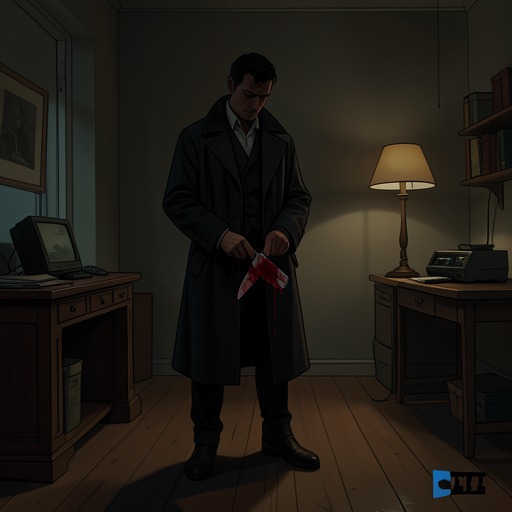
José Sáez García
Los renglones torcidos de DiosJosé Sáez García, known to the other residents as the Hombre Elefante, is a long-term patient whose history makes the hospital’s promise of freedom uneasy: after decades inside, he is permitted to leave, and that brief absence coincides with a killing. Alice Gould’s examination of his file turns the details of his confinement and release into a key thread in her investigation.
Identity and Institutional Setting
José had been in the hospital for nearly forty years. His admission had been requested by his uncle, Severiano García del Olmo, and the arrangement later acquires a grim significance: when the hospital introduced its open regime, José was allowed out for three days, the second of which coincided with his uncle’s murder. The release was exceptional in its circumstances, not evidence that the hospital’s boundaries had disappeared. Under the open regime, residents could move around the building and grounds and, with permission, travel to nearby villages; the system’s relative liberty still had many exceptions.
Violence, Motive, and the Murder Investigation
The danger associated with José was not confined to an old crime. The director told the commissioner that, less than a month earlier, José had killed a young man with an intellectual disability. Alice’s later reconstruction links that violence to the killing of Remo, the twin: José had mistaken him for Romulus and killed him by leaping onto him, crushing his chest and rupturing his internal organs. The same distinctive method, Alice concluded, had been used against Raimundo García del Olmo’s father—not a sandbag beating, as the earlier account suggested, but an assault matching Remo’s death.
Alice found the connection by seizing a brief opportunity to inspect the relevant file. While the commissioner looked through her own papers and waited for the young Romulus to appear, she examined José’s record and discovered that he had been admitted at the request of his uncle, Severiano García del Olmo. The release record sharpened the suspicion: after thirty-eight years in the hospital, José had been permitted to leave for only one period, and the second day of that three-day absence coincided with the murder of the uncle who had arranged his confinement.
The pattern gave the violence a personal logic. Alice reasoned that José had hated his uncle for sending him to the asylum and his cousin, whom residents regarded as the clever one, simply for possessing that distinction. In her account, the deaths of Severiano and Remo therefore belonged to a continuing logic of revenge, not to unrelated episodes. José’s rare excursion under the open regime became the point at which institutional permission, a family grievance, and a repeated method converged, allowing Alice to connect crimes separated by decades.
Reform and Its Limits
César Arellano’s defense of psychiatric reform supplies a wider institutional frame for José’s rare movement beyond the hospital: removing bars can ease the oppressive sense of confinement, Arellano argues, but such measures require an infrastructure capable of making them work. The distinction matters in José’s case because formal openness did not erase the power of confinement or guarantee that a release would be ordinary. His history exposes the tension between reform as a humane principle and the conditions needed to put it into practice.
Characterization Through the Case File
José is presented less through a direct scene of his own than through the records and testimony that make his history legible to Alice. His admission papers identify the uncle who arranged his confinement; the dates of his rare three-day leave place him outside the hospital when that uncle was murdered; and the director’s report of a recent killing establishes that the danger was not merely historical. Alice then distinguishes the documented pattern of violence from her interpretation of its motive, connecting the deaths through José’s resentment of his uncle and cousin. This indirect construction makes the hospital file more than administrative paperwork: it becomes the evidence through which a patient’s decades-long confinement, a family grievance, and a sequence of killings converge.